English
 Italian
 French
 German
 Spanish
EBS explores the role of balancing in next-generation UAV systems
A technological evolution redefining vibration control in civil and military drones
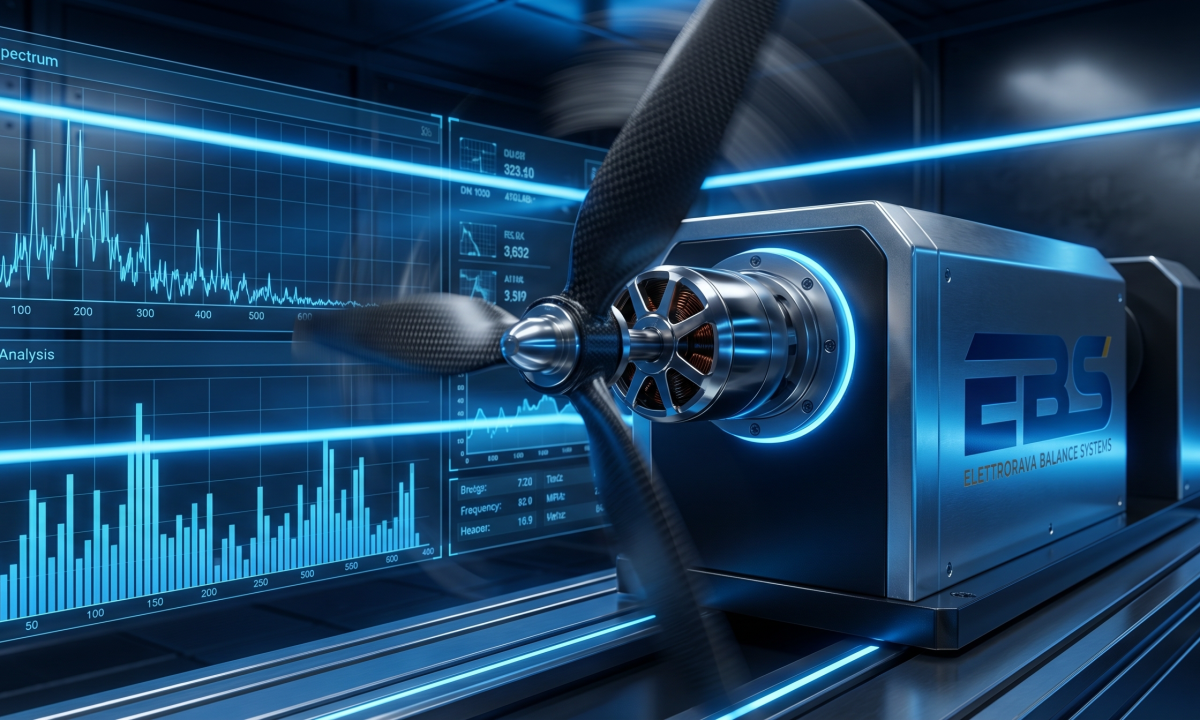
EBS presents a new technical insight dedicated to the balancing of rotating components in UAV (Unmanned Aerial Vehicle) systems, a topic that has become increasingly central in the development of high-performance drones in recent years.
The evolution of UAV systems has led to a significant increase in rotational speeds, a reduction in structural mass, and a deeper integration between propulsion, electronics, and sensing systems. This has turned drones into highly sensitive dynamic platforms, where even minimal imbalances can generate significant effects on the overall system.
In particular, vibrations generated by rotating components can directly affect:
- flight control stability
- inertial measurement system accuracy (IMU)
- data quality from gimbals and optical sensors
- overall propulsion system efficiency
A systemic approach to balancing
In the new technical insight, EBS analyzes how balancing in UAV systems can no longer be limited to the single component, but must be extended to the entire rotating system.
The main involved elements include:
- propellers and high-speed brushless rotors
- motor shafts and coupling systems
- cooling fans and auxiliary actuators
- stabilized gimbal systems
- rotating payloads such as LiDAR and radar
This complexity requires a multi-level engineering approach that includes:
- component balancing
- assembly balancing
- validation under real operating conditions
The EBS range: scalable balancing solutions for every level of automation
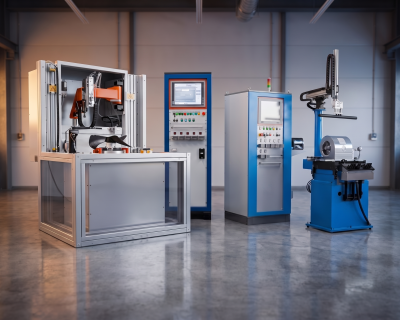
To flexibly address the diverse production requirements of the UAV sector and, more broadly, high-precision rotating components, EBS has developed a complete range of balancing machines capable of adapting to different levels of automation and production volumes.
The platform includes solutions such as:
- R10 and R100 for manual or semi-assisted balancing applications, ideal for development, prototyping, and small series production
- R300 and R800 for industrial production environments requiring higher repeatability and process integration
- R2K for advanced configurations designed for high-volume production and maximum automation
This modular architecture allows coverage of the full application spectrum: from manual adjustment of a single component to fully automated systems.
The different automation levels include:
- manual loading for flexible production
- operator-assisted systems to reduce cycle time and variability
- fully automated solutions with robotic loading for high-volume manufacturing
The EBS approach: testing, analysis, and validation
Over the years, EBS has developed an engineering approach based on experimental analysis and operational testing across various UAV rotating component configurations.
This work has enabled:
- correlation between imbalance and real dynamic operating conditions
- vibration behavior analysis in high-speed systems
- development of high-precision balancing solutions for micro-components
- integration of vibration measurement and control into production processes
The experience gained has shown that vibration issues in drones are not isolated, but arise from the complex interaction of multiple rotating subsystems.
A contribution to the design of future UAV systems
Balancing is no longer a final production step, but a structural element of UAV system design.
Through its technologies and scalable range of balancing machines, EBS supports the industry in advanced vibration management, contributing to improved:
- flight stability and controllability
- mission-critical data quality and reliability
- system energy efficiency
- component durability and robustness
Speak with a specialist engineer
If you are developing or manufacturing rotating components for UAV applications and would like to explore how to improve vibration control and balancing in your system, our technical team is available for a direct discussion.